#Cemetery
National War Cemetery Grebbeberg
Immediately after the Netherlands surrendered, a cemetery was laid out at the battle site for both Dutch and German military personnel who died during the Battle of the Grebbeberg. The number of Dutch soldiers killed during the Battle of the Grebbeberg totals 425. German losses were significantly lower, though the exact number is no longer traceable—it was certainly no more than 200. The Military Cemetery of Honor Grebbeberg near Rhenen is the first official war cemetery in the Netherlands. It was the German occupier who designated this location on the Grebbeberg for the burial of fallen Dutch and German soldiers.
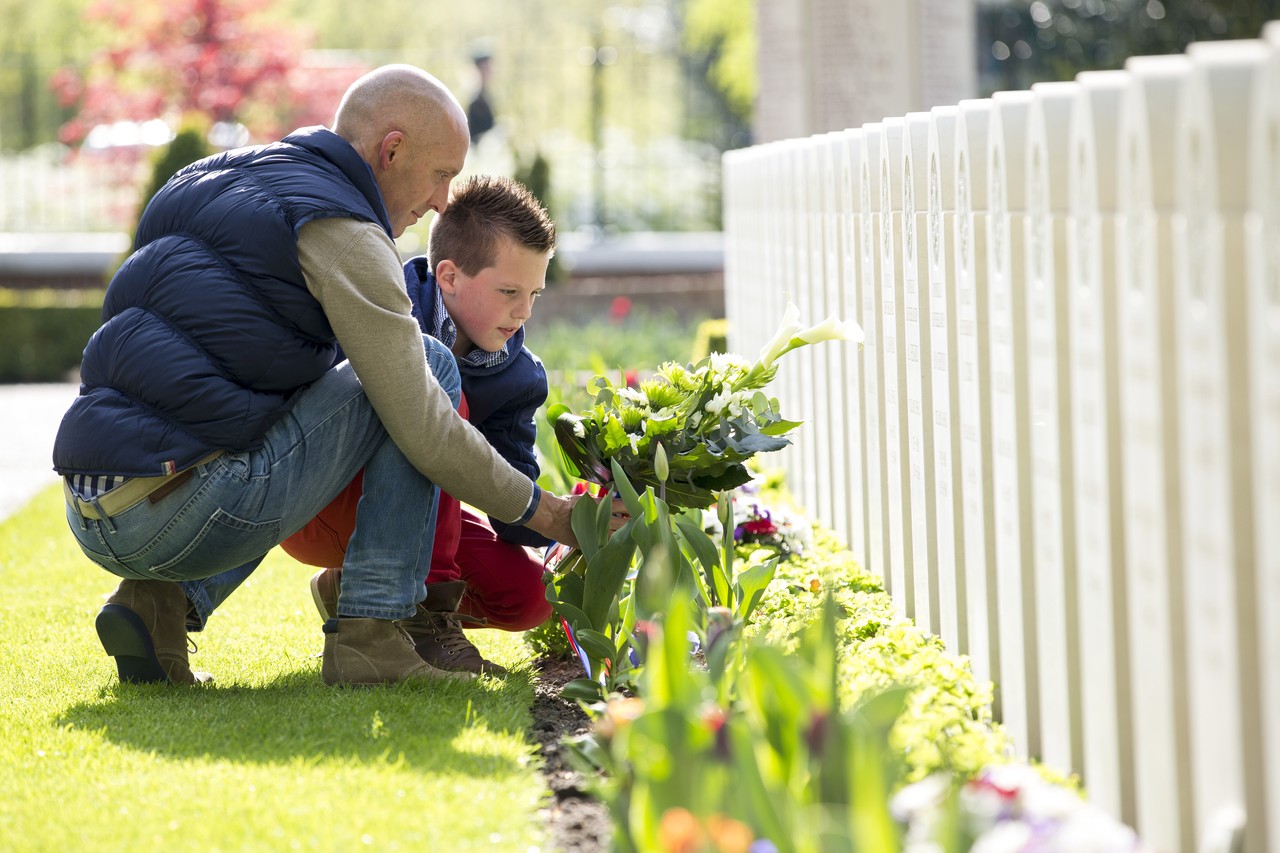
On 16 May 1940, just one day after the Dutch surrender, the collection, registration, and burial of Dutch and German soldiers who had lost their lives in the battle began. For three days, the Red Cross, the Air Raid Protection Service, Arnhem scouts, and civilians from Elst and Rhenen worked tirelessly. By 18 May, most of the Dutch military personnel who had fallen in the area were given a final resting place on the Grebbeberg.
Starting on 27 May, the remains from the field graves on and around the Grebbeberg were transferred to the cemetery. By the end of June 1940, 395 Dutch soldiers were buried there. Of the Germans killed in the battle, approximately 110 soldiers were given a temporary resting place at this cemetery, while others were buried at Ehrenfriedhof Zypendaal near Arnhem or repatriated to Germany. However, German soldiers who fell elsewhere in the Grebbe Line or the Betuwe region during those first days of the war were also buried at Grebbeberg.
The cemetery did not remain quiet afterward. Throughout the subsequent war years, many more German soldiers—who lost their lives in the Netherlands due to illness, accidents, Allied attacks, and particularly Operation Market Garden—were buried at Grebbeberg. The number of German soldiers buried there grew to nearly 700 during the war. In May 1947, all these German soldiers were reburied at the German Military Cemetery Ysselsteyn in the Peel region.
Not only were the Dutch casualties from the May days of 1940 buried at Grebbeberg, but also men from units such as the Princess Irene Brigade and the 320 Squadron, who were killed in the final years of the war, found their final resting place here.
To this day, reburials occasionally take place at Grebbeberg for Dutch soldiers whose graves elsewhere in the Netherlands have fallen into disrepair or are at risk of being cleared. These soldiers are then transferred to this Cemetery of Honor.
The last unknown soldier at Grebbeberg was identified in 2011. A DNA test restored his name—W.F. Brummelhuis from Bornerbroek, as had been suspected.
The Military Cemetery of Honor now contains over 860 graves, roughly half of which belong to soldiers who did not survive the Battle of the Grebbeberg. Many stories converge here—stories of battles on water, along the lines, and in the air. But above all, stories of courage and sacrifice. This cemetery, managed and maintained by the Dutch War Graves Foundation, is the final resting place for all these victims, whatever their story may be.